
Publications
Papers & Books By Our Founder
Robet T. Zappalorti
Zappalorti, R.T. 1976. The Amateur Zoologist’s Guide to Turtles and Crocodilians. Stackpole Books, Harrisburg, Pennsylvania. 208 pp.
Zappalorti, R.T. 1978a. The bog turtle, smallest of North American turtles. Bulletin of the Chicago Herpetological Society 13(3):75–81.
Zappalorti, R.T. 1978b. Care of pet turtles and tortoises. Popular Pets Magazine, January 1978, 23–26.
Zappalorti, R.T. 1979. History of reptiles and amphibians. In: The Academic American Encyclopedia, pp. 26–41. Arete Publishing Company, Inc., Princeton, New Jersey.
Zappalorti, R.T. 1980. A herpetological survey of the Manasquan River flood plain in the vicitity of the proposed Oak Glen Reservoir System Project. Herpetological Associates, Inc., Wildlife Consultants, 405 Magnolia Road, Pemberton, New Jersey 08068.
Zappalorti, R.T. 2008. Where have all the indigo snakes gone? Florida Wildlife Magazine, January/February 2008. Florida Wildlife Conservation Commission.
Zappalorti, R.T. 2013. Herpetofauna of the New Jersey Pine Barrens. Herpetological Associates, Inc. Wildlife Consultants, 405 Magnolia Road, Pemberton, NJ 08068.
Zappalorti, R.T. 2016c. Review, recommendations and support for listing the Louisiana Pinesnake (Pituophis ruthveni) as a federally threatened species—Part I. Herpetological Associates, Inc. and Zappalorti Institute for Pinelands Research, Pemberton, New Jersey. 25 pp.
Zappalorti, R.T. 1990. The musk turtle. In: Reptile & Amphibian Magazine, Mar./Apr. 1990, 44–48. Philadelphia, Pennsylvania.
Zappalorti, R.T. 1995a. Marsh turtles. In: L.E. Dove and R.M. Nyman (eds.), Living Resources of the Delaware Estuary, pp. 311–319. The Delaware Estuary Program Publication, July 1995.
Zappalorti, R.T. 1995b. Vernal pool breeders. In: L.E. Dove and R.M. Nyman (eds.), Living Resources of the Delaware Estuary, pp. 321–330. The Delaware Estuary Program Publication, July 1995..
Zappalorti, R.T. 1997. Turtles of New Jersey and the bog turtle in the Northeast. In: Tom Tyning (ed.), Status and Conservation of Turtles of the Northeastern United States, pp.15–22. Massachusetts Audubon Society, Serpent’s Tale Natural History Book Distributors, Lanesboro, Minnesota
Zappalorti, R.T. 2009. A frog is a friend forever. In: J. K. Reaser (ed.), Courting the Wild: Love Affairs with Reptiles and Amphibians, pp. 211–215 (Chapter 26). Hirath Press, San Francisco.
Zappalorti, R.T. 2018. Experimental Translocation of the Eastern Tiger Salamander in New Jersey: A Conservation Success Story. Herpetological Associates, Inc. Wildlife Consultants, Pemberton, New Jersey. 22 pp.
Zappalorti, R.T. 2016b. Do drift fences, in conjunction with funnel box traps, capture secretive terrestrial snakes? Herpetological Associates, Inc., Pemberton, New Jersey. 34 pp. Herpetological Associates, Inc. Wildlife Consultants, 405 Magnolia Road, Pemberton, NJ 08068
The Natural History Of
NewJersey’s Reptiles
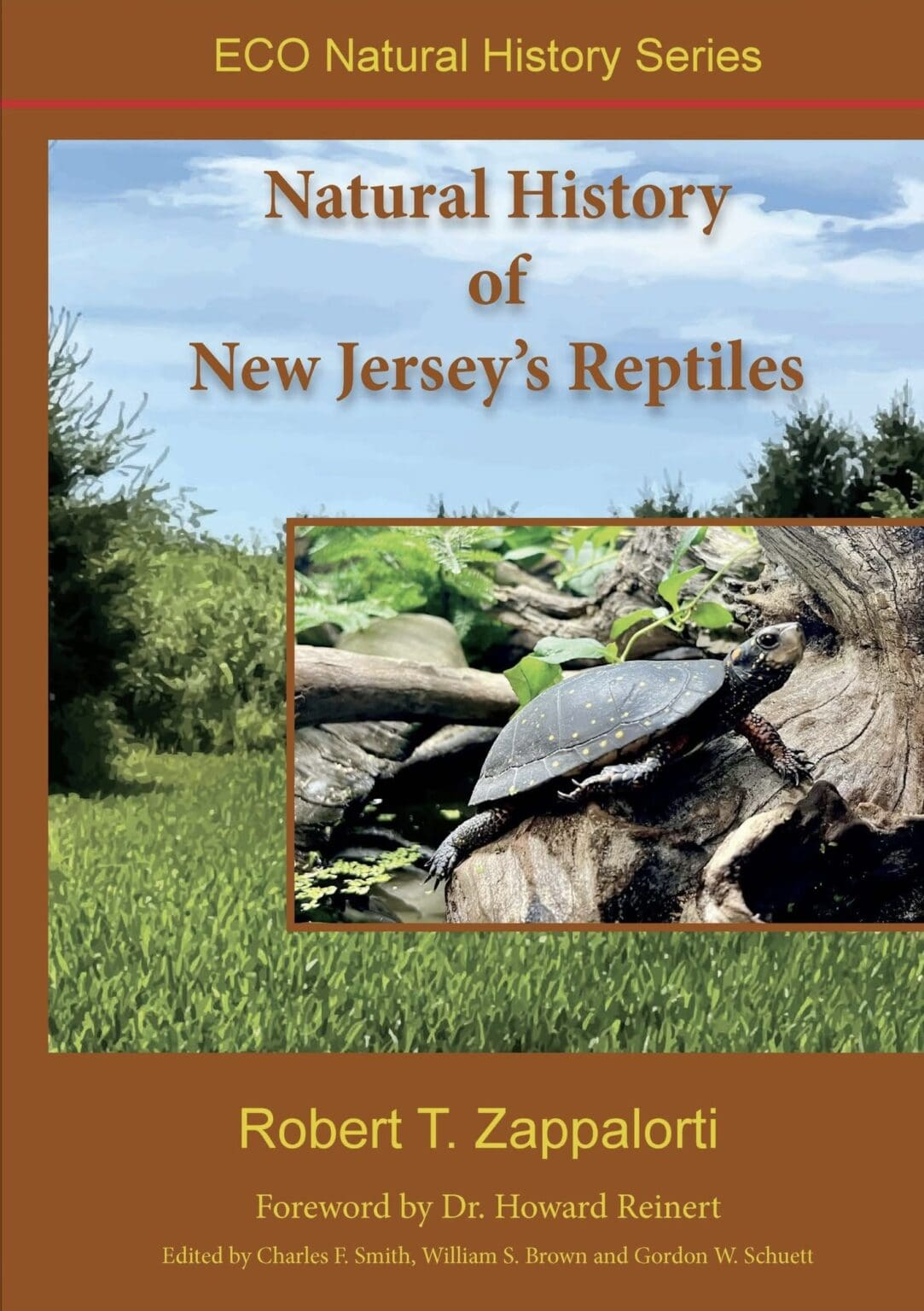
Praise for New Jersey’s Reptiles
In this attractive new book Natural History of New Jersey’s Reptiles, Bob Zappalorti shows the reader why this well-known field biologist is considered the leading reptile expert in the state of New Jersey.
In this modern, well-organized tome, Zappalorti provides his study methods and full species accounts documenting the life-histories of 19 turtles, 5 lizards, and 22 snakes extant in the state.
After covering basic taxonomic principles and evolutionary history along with a glossary of commonly used terms, the species descriptions are illustrated with numerous high-quality photographs allowing their identification by both amateur and professional herpetologists. For each species, accepted taxonomic relationships, national and state ranges, reproduction, growth and age, behavior, and survival status are fully covered.
Perhaps the greatest of the author’s contributions in this book are a large number of his detailed personal observations of the “secret” lives of turtles, lizards, and snakes that could only have been obtained through many decades spent in the field.
Naturalists, environmental researchers, and managers interested in these fascinating animals cannot afford to miss this opportunity to enjoy Bob Zappalorti’s first-time revelations through a lifetime studying the habitats and habits of reptiles in the ecologically diverse state of New Jersey.
William S. Brown, Ph.D.
Associate Professor Emeritus
Biology Department, Skidmore College
Saratoga Springs, New York
The Natural History Of New Jersey’s Reptiles by ECO Publishing. The paperback edition sells for $24.95. Click here to check site for availability.
The Natural History Of
New Jersey’s Amphibians
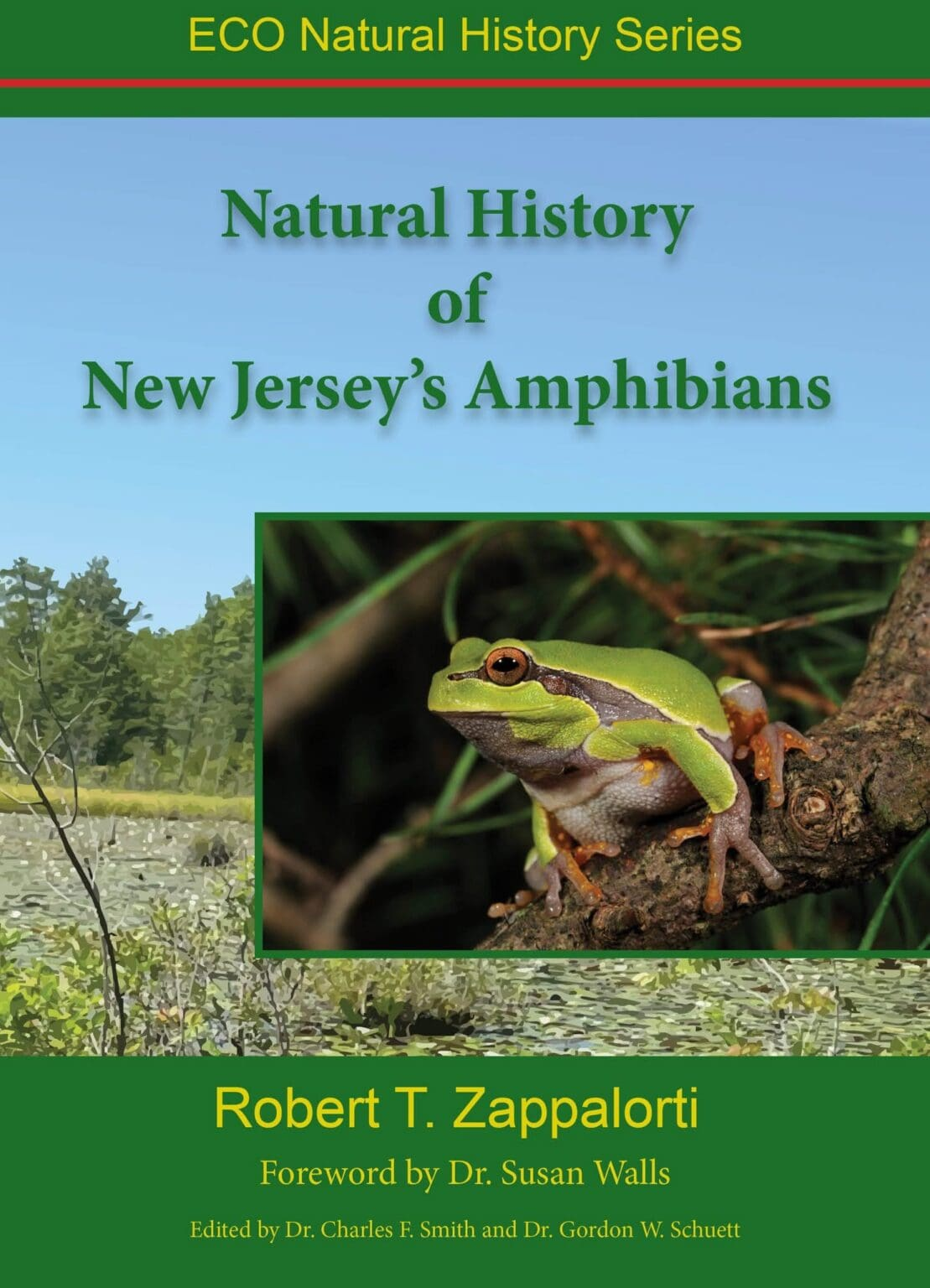
Praise for New Jersey’s Amphibians
New Jersey is situated at a unique biogeographic transition zone between the southern Atlantic Coastal Plain and the rugged northeastern Appalachian Mountains.
As such, it is home to a diverse amphibian fauna with both northern and southern affinities, a fauna that has never before been adequately described or summarized. Robert Zappalorti’s Natural History of New Jersey’s Amphibians admirably fills that void and undoubtedly will lead to a much greater appreciation of the salamanders and frogs in the Garden State.
No one could better describe New Jersey’s amphibians than Bob Zappalorti, a scientist–naturalist with more than 60 years of field experience from the Pine Barrens in the south to the rugged northern highlands.
This guide will appeal to naturalists, scientists, and outdoor enthusiasts, and will lead to a better understanding of New Jersey’s biodiversity and the need to conserve amphibians and their habitats. Highly recommended!
C. Kenneth Dodd, Jr., Ph.D.
Author: Frogs of the United States and Canada
IUCN Amphibian Specialist Group
The Natural History Of New Jersey’s Amphibians by ECO Publishing. The paperback edition sells for $24.95. Click here to check for availability.
Leather Bound Collector’s Edition–
Natural History of New Jersey’s Amphibians
Natural History of New Jersey’s Reptiles
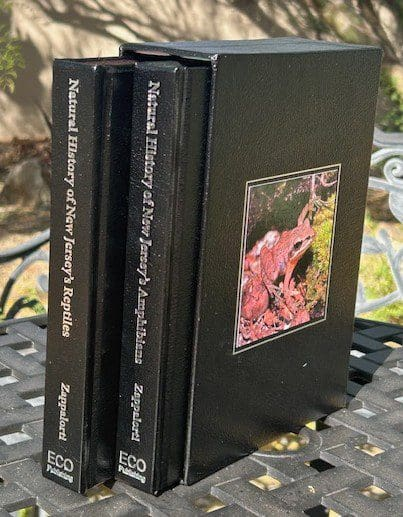
Special Limited Edition Only 100 sets made
Contrary to popular opinion, New Jersey’s diversity of reptiles is remarkable, with 46 species of lizards, snakes, and turtles.
This authoritative book by Robert Zappalorti introduces the reader to these splendid creatures. He covers all aspects of identification, ecology, behavior, and natural history for each species.
Well written, easy to follow, and replete with photographs, this book is a must for both professional and amateur biologists seeking to know more about the herpetological wonders of New Jersey.
New Jersey is home to a wide diversity of amphibians consisting of 34 species of frogs, toads, and salamanders. The author, a leading authority, takes the reader on a journey describing each of the species in detail—from identification, life-cycles, behavior, and other aspects of natural history.
This book is highly recommended for all individuals with a keen interest in this group of vertebrates. Make sure you have a copy in your backpack on your next visit to the Garden State.
New Jersey is situated at a unique biogeographic transition zone between the southern Atlantic Coastal Plain and the rugged northeastern Appalachian Mountains. As such, it is home to a diverse amphibian fauna with both northern and southern affinities, a fauna that has never before been adequately described or summarized.
Robert Zappalorti’s Natural History of New Jersey’s Amphibians admirably fills that void and undoubtedly will lead to a much greater appreciation of the salamanders and frogs in the Garden State. No one could better describe New Jersey’s amphibians than Bob Zappalorti, a scientist–naturalist with more than 60 years of field experience from the Pine Barrens in the south to the rugged northern highlands.
This guide will appeal to naturalists, scientists, and outdoor enthusiasts, and will lead to a better understanding of New Jersey’s biodiversity and the need to conserve amphibians and their habitats. Highly recommended!
- Kenneth Dodd, Jr., Ph.D.
Author: Frogs of the United States and Canada
IUCN Amphibian Specialist Group
Leather Bound Colletcor’s Edition – Natural History of New Jersey’s Amphibians and Natural History of New Jersey’s Reptiles, by ECO Publishing. The Collector’s edition sells for $119.95
Click here to check site for availability.y.
The Bog Turtle,
Natural History
& Conservation
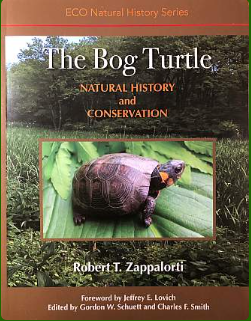
The bog turtle belongs to the large family Emydidae, which includes semi-aquatic pond and marsh turtles known for their colorful and diverse hard shells in the United States.
Unfortunately, bog turtle populations have gradually declined across their entire range due to habitat loss, fragmentation of connecting habitats, wetland pollution, and illegal collection.
This book offers in-depth natural history information on bog turtles, covering their taxonomic background, survival tactics, predators, reproductive biology, foraging habits, diet, habitat preferences, hibernation strategies, and conservation efforts.
Author Robert T. Zappalorti guides readers through a step-by-step journey to explore the fascinating world of this unique turtle. Welcome to the secret world of the bog turtle.
The Bog Turtle Natural History & Conservation by ECO Publishing. The paperback edition sells for $29.95.
Click here to check for availability.
The Bog Turtle – Leatherbound
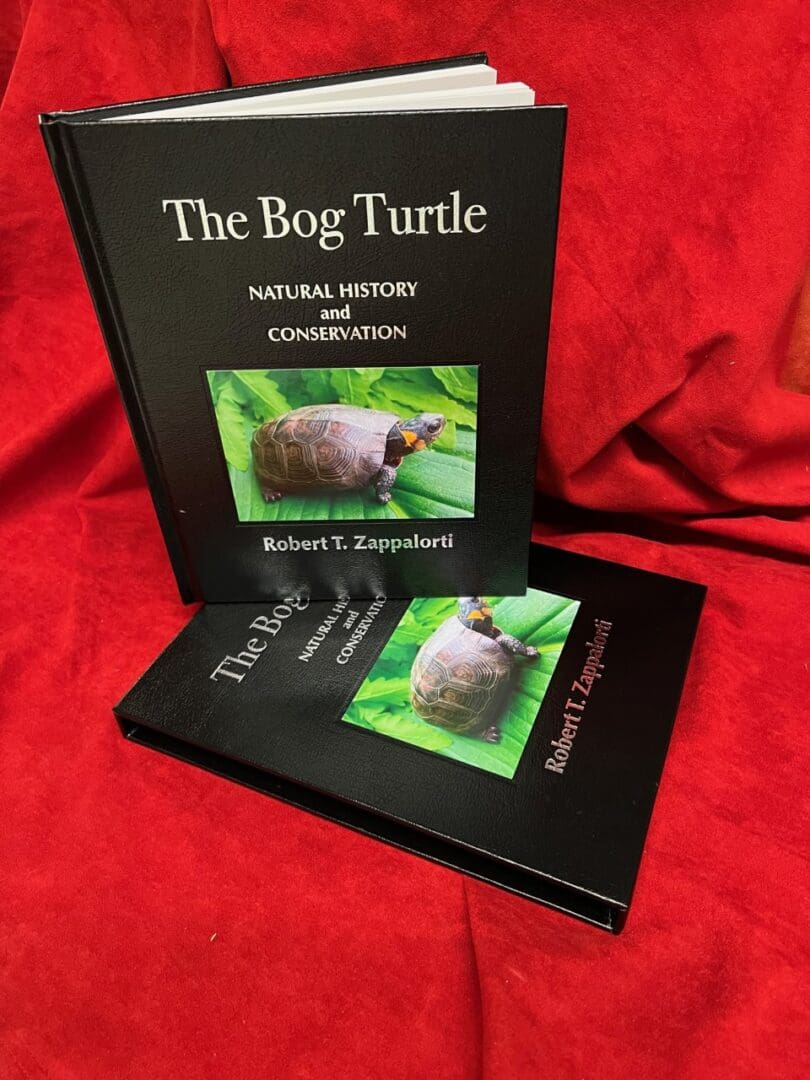
There is also a limited leather-bound collector’s edition that sells for $129.95.
Click here to check for availability.
The Natural History Of The
Northern Pine Snake.
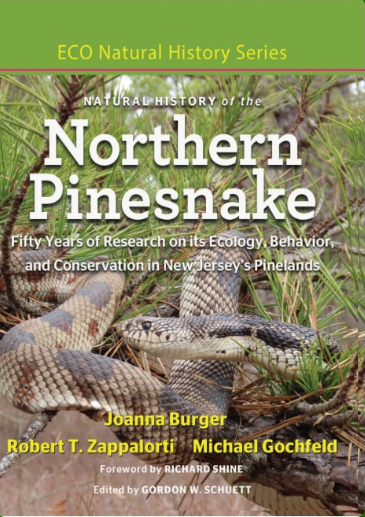
Fifty Years of Research on its Ecology, Behavior, and Conservation in New Jersey’s Pinelands. Natural History of the Northern Pine Snake, our newest addition to the ECO Natural Series, is the ultimate book on this species.
After 50 years of field research by the authors, this publication fully captures the essence of this species life, lore, and mystery. Ultimately, you will gain a deep understanding and appreciation of the role these snakes and many other species of plants and animals have in the endangered pinelands of New Jersey.
As you consume the chapters, you will find yourself falling in love with these amazing snakes.
Authors: Joanna Burger, Robert T. Zappalorti, and Michael Gochfeld
Foreword: Richard Shine, Edited by: Gordon W. Schuett
The Natural History of the Northern Pine Snake is available by ECO Publishing. The paperback edition sells for $24.95. Click here to check for availability.
Stain Glass Windows
The Life & Death Of James Zappalorti

The Stain Glass Windows by Robert T. Zappalorti
Published and distributed by
Words Take Flight Books
is available now
Words Take Flight Books
Publication date: September 2014
ISBN: 978-0692291771
Availability:
Kindle – $8.99
Paperback – $17.95
Click the blue link of the version to purchase through Amazon above
In January 1990, two Staten Island men, Michael Taylor and Philip Sarlo, brutally murdered Jimmy Zappalorti – not for money, not for revenge, but out of prejudice and hatred: Jimmy was a gay man. Beaten. Stabbed.
His body thrown in the Arthur Kill to hide the crime. But Jimmy was found – and humanity rallied around the inhumanity. Taylor and Sarlo tried to silence Jimmy for being gay – but they only succeeded in giving a voice to change. Jimmy’s killing fanned a firestorm of outrage among citizens groups, politicians and the LGBT community that led to the signing on July 10, 2000, of The New York State Hate Crimes Bill – the first of its kind in the state.
Stained Glass Windows chronicles Jimmy’s life, death and its aftermath, from his youth in a loving, fiercely religious family, through his recognition of his homosexuality in the US Navy and the subsequent heinous physical assault on him and his partner, and shipmate, in Vietnam.
After being medically discharged, Jimmy returned home bearing his invisible physical and psychological scars – and the ongoing conflict between his homosexuality and his Catholic parents and upbringing would pick at those never-healing wounds. But for all of his struggles, for the rest of his all-too-brief life, Jimmy was known as a peaceful, loving man who simply wanted to “be” – to live in his “beach house” by the Arthur Kill, spend time with friends and family, and play the piano.
And it is this that makes the timing of the publication of Stained Glass Windows even more crucial.
In October 2014, one of the two men, Michael Taylor, serving prison time for Jimmy’s murder is due for parole – Philip Sarlo died in prison in 1997. Said Mr. Zappalorti, “It is appropriate that one month before he has the chance to be freed from a life sentence that the world should hear the story of the man whose life he callously took – Jimmy Zappalorti – and that of the family he devastated by a son’s and brother’s murder.”
Mr. Zappalorti tells Jimmy’s story in his own voice: that of a brother who was Jimmy’s protector in life and champion after his death, whose efforts continue to keep Jimmy’s legacy alive to help maintain the fight for LGBT rights through the New York City-based, not-for-profit organization The Zappalorti Society. Founded by Robert “Bert” Coffman, it is an active group of LGBT psychiatric survivors organized for peer support, self-help and mental health advocacy.
Robert T. Zappalorti manages an environmental consulting business, Herpetological Associates, Inc., Plant and Wildlife Consultants. He is also an accomplished photographer, writer and actor. Working in his spare time, he wrote three different drafts of this book over a span of fifteen years.
Copyright 2011 Words Take Flight Books™. All rights reserved.
The Stain Glass Windows by Robert T. Zappalorti
Published and distributed by
Words Take Flight Books
is available now
Words Take Flight Books
Co-Authored Publications:
Beane, J.C. and R.T. Zappalorti. 1997. Natural history notes: Clemmys muhlenbergii (bog turtle), parasitism. Herpetological Review 28(3):148–149.
Bickhart, T.M., M.E. Torocco, and R.T. Zappalorti. 2012. 2009–2010 Progress Report: Bog Turtle (Glyptemys muhlenbergii) population assessment surveys, radiotelemetry, and nest studies at xxxxxxxx and xxxxxxxx, Lancaster County, Pennsylvannia. Herpetological Associates, Inc., 581 Airport Road, Bethel, Pennsylvannia, 19507.
Burger, J., and R.T. Zappalorti. 1986. Nest site selection by pine snakes, (Pituophis melanoleucus), in the New Jersey Pine Barrens. Copeia 1986(1):116–121.
Burger, J., and R.T. Zappalorti. 1988a. Effects of incubation temperature on sex ratios in pine snakes: differential vulnerability of males and females. The American Naturalist (4):129–132, October 1988.
Burger, J., and R.T. Zappalorti. 1988b. Habitat use in free-ranging pine snakes, Pituophis melanoleucus, in the New Jersey Pine Barrens. Herpetologica 44(1):48–55.
Burger, J., and R.T. Zappalorti. 1989. Habitat use by pine snakes (Pituophis melanoleucus) in the New Jersey Pine Barrens: Individual and sexual variation. Journal of Herpetology 23(1):68–73.
Burger, J., and R.T. Zappalorti. 1992. Philopatry and nesting phenology of pine snakes Pituophis melanoleucus in the New Jersey Pine Barrens. Behav. Ecol. Sociobiol. (1992) 30:331–336.
Burger, J., and R.T. Zappalorti. 2011a. Effects of handling, marking, and recapturing pine snakes (Pituophis m. melanoleucus) from the New Jersey Pine Barrens. Journal of Environmental Indicators 6:17–32.
Burger, J., and R.T. Zappalorti. 2011b. The northern pine snake (Pituophis m. melanoleucus) in New Jersey: Its life history, behavior and conservation. In: Kristin J. Baker (ed.), Reptiles: Biology, Behavior and Conservation, pp. 1–56 (Chapter 1). Nova Science Publishers, Hauppauge, New York. 215 pp.
Burger, J., and R.T. Zappalorti. 2015. Hibernation site philopatry in Northern Pine Snakes (Pituophis melanoleucus) in New Jersey. Journal of Herpetology, 49(2): 245–251.
Burger, J., and R.T. Zappalorti. 2016. Conservation and protection of threatened pine snakes (Pituophis melanoleucus) in the New Jersey Pine Barrens, USA. Herpetological Conservation and Biology 11(2):304–314.
Burger, J., R.T. Zappalorti, and M. Gochfeld. 1987. Developmental effects of incubation temperature on hatchling pine snakes (Pituophis melanoleucus). Comp. Biochem. Physiol. 87A(3):727–732.
Burger, J., R.T. Zappalorti, J. Dowdell, T. Georgiadis, J. Hill, and M. Gochfeld. 1992. Subterranean predation on pine snakes (Pituophis melanoleucus). Journal of Herpetology, 26(3): 259–263.
Burger, J., R.T. Zappalorti, and M. Gochfeld. 2000. The defensive behaviors of pine snakes (Pituophis melanoleucus) and Black Racers (Coluber constrictor) to Disturbance During Hibernation. Herp. Natural History 7:59–66.
Burger, J., R.T. Zappalorti, M. Gochfeld, and E. Devito. 2007. Effects of off-road vehicles on reproductive success of pine snakes (Pituophis melanoleucus) in the New Jersey Pinelands. Urban Ecosyst (2007) 10:275–284.
Burger, J., R.T. Zappalorti, M. Gochfeld, E. Devito, D. Schneider, M. McCort, and C. Jeitner. 2012. Long-term use of hibernacula by northern pine snakes (Pituophis melanoleucus). Journal of Herpetology 46(4):596–601.
Burger, J., M. Gochfeld, C.W. Powers, L. Niles, R. Zappalorti, J. Feinberg, and J. Clarke. 2013. Habitat protection for sensitive species: Balancing species requirements and human constraints using bioindicators as examples. Natural Science 5(5A)50–62.
Burger, J., R.T. Zappalorti, and M. Gochfeld. 2018. Hatchling survival to breeding age in northern pine snakes (Pituophis melanoleucus) in the New Jersey Pine Barrens: Human effects on recruitment from 1986 to 2017. PLoS ONE 13(5): e0195676. https://doi.org/10.1371/journal.pone.0195676.
Burger, J., R.T. Zappalorti, M. Gochfeld, C. Jeitnera, E. DeVito, and J. Howell. 2019. A paradigm for information needed to protect at-risk species: northern pine snake (Pituophis melanoleucus) in the pine barrens as a case study. Journal of toxicology and Environmental Health, Part A. https://doi.org/10.1080/15287394.2019.1615587.
Burger, J., R.T. Zappalorti, M. Gochfeld, and E. Devito. 2021. The importance of paleodunes as nesting habitat for northern pine snakes (Pituophis melanoleucus melanoleucus): risk from off-road vehicles in the New Jersey Pine Barrens. Urban Ecosyst (2021). https://doi.org/10.1007/s11252-021-01161-z.
Burger, J., R.T. Zappalorti, M. Gochfeld, E. Devito, and C. Jeitner. 2021. Trade-offs and vulnerability of northern pine snakes (Pituophis m. melanoleucus): A comparison of nest-site selection in the early 1980s and 2020. Herpetologica 77(3). DOI: 10.1655/Herpetologica-D-21-0001.1.
Campbell, L.J. , J. Burger, R.T. Zappalorti, J.F. Bunnell, M.E. Winzeler, D.R. Taylor, and J,M. Lorch. 2021. Soil reservoir dynamics of Ophidiomyces ophidiicola, the causative agent of snake fungal disease. Journal of Fungi — Open Access Mycology Journal, June 2021 DOI: 10.3390/jof7060461.
Ernst, C.H., R.T. Zappalorti, and J.E. Lovich. 1989. Overwintering sites and thermal relations of hibernating bog turtles (Clemmys muhlenbergii). Copeia 1989:761–764.
Farrell, F., R.T. Zappalorti, A. Figueroa, and T. Bickhart. 2002. Progress report on 2002 field season and hatching success of the Bog Turtle in the xxxxxxxx and xxxxxxxx drainage basins, Monroe County, Pennsylvania. Herpetological Associates, 405 Magnolia Road, Pemberton, New Jersey 08068.
Farrell, R.F., R.T. Zappalorti, M.P. McCort, and M.E. Torocco. 2002. Bog Turtle survey and radiotelemetry study at xxxxxxxx fen complex, Northampton County, Pennsylvania. Herpetological Associates, 405 Magnolia Road, Pemberton, New Jersey 08068.
Farrell, F., R. Zappalorti, M. Torocco, T. Bickhart, and A. Figueroa. 2004. Results of Bog Turtle (Clemmys muhlenbergii) surveys in various watersheds in Monroe County, Pennsylvania during 2002 and 2003. Herpetological Associates, Inc. Wildlife Consultants, 405 Magnolia Road, Pemberton, NJ 08068.
Frier, J., and R.T. Zappalorti. 1983. Reptile and amphibian management techniques. Transactions of the North American Wildlife Society 40:142–148.
Hulmes, D.P., and R.T. Zappalorti. 1981. Notes on the ecology and distribution of the Pine Barrens treefrog, Hyla andersonii, in New Jersey. Bull. New York Herp. Soc. 17(1).
Kyle, K.E., M.C. Allen, J. Dragon, J.F. Bunnell, H.K. Reinert, R. Zappalorti, B.D. Jaffe, J.C. Angle, and J.L. Lockwood. 2022. Combining surface and soil environmental DNA with artificial cover objects to improve terrestrial reptile survey detection. Conservation Biology, May 2022 DOI: 10.1111/cobi.13939.
Lovich, J.E., C.H. Ernst, R.T. Zappalorti, and D.W. Herman. 1998. Geographic variation in growth and sexual size dimorphism of bog turtles (Clemmys muhlenbergii). The American Midland Naturalist 139(1):69–78.
Reed, R.N., C.A. Young, and R.T. Zappalorti. 2012. Snake hibernacula and communal denning. In: R.W. McDiarmid, M.S. Foster, C. Guyer, J.W. Gibbons, and N. Chernoff (eds). Reptile Biodiversity, Standard Methods for Inventory and Monitoring, pp. 167–196 (Chapter 11). University of California Press. Oakland, California.
Reinert, H.K., G.A. MacGregor, M. Esch, L,M. Bushar, R.T. Zappalorti. 2011. Foraging Ecology of Timber Rattlesnakes, Crotalus horridus. Copeia 2011, 3: 430–442.
Reinert, H.K., and R.T. Zappalorti. 1988a. Timber rattlesnakes of the Pine Barrens (Crotalus horridus): Their movement patterns and habitat preference. Copeia 1988:964–978.
Reinert, H.K., and R.T. Zappalorti. 1988b. Field observations of the association of adult and natal timber rattlesnakes (Crotalus horridus), with possible evidence of conspecific trailing. Copeia 1988:1057–1059.
Rudolph, D.C., S.J. Burgdorf, R.R. Schaefer, R.N. Conner, and R.T. Zappalorti. 1998. Snake mortality associated with late season radio–transmitter implantation. Herpetological Review 29(3):155–156.
Smith, H.M., R.T. Zappalorti, A.R. Briesch, and D.L. McKinley. 1995. The type locality of the cricket frog (Acris crepitans). Herpetological Review 26:14.
Stevenson, D.J., K.R. Ravenscroft, R.T. Zappalorti, M.D. Ravenscroft, S.W. Weigley, and C.L. Jenkins. 2010. Using a wildlife detector dog for locating eastern indigo snakes (Drymarchon couperi). Herpetological Review 41(4), 437–442.
Sutton, C.C., J.C. O’Herron, II, and R.T. Zappalorti. 1996. The scientific characterization of the Delaware Estuary. The Delaware Estuary Program (DRBC Project No. 321; HA File No. 93.21). 200 pp. and appendices.
You, C.-W., Y.-P. Lin, Y.-H. Lai, Y.-L. Chen, Y. Tang, S.-P. Chou, H.-Y. Chang, R.T. Zappalorti, and S.-M. Lin. 2013. Return of the pythons: First formal records, with a special note on recovery of the Burmese python in the demilitarized Kinmen islands. Zoological Studies 2013, 52:8.
Wund, M.A., M.E. Torocco, R.T. Zappalorti, and H.K. Reinert. 2007. Activity ranges and habitat use of Lampropeltis getula getula (eastern king snakes). Northeastern Naturalist 14(3):343–360.
Zappalorti, R.T., and J. Bockowski. 1965. The northern cricket frog (Acris crepitans) on Staten Island, New York. Bulletin of the New York Herpetological Society 25.
Zappalorti, R.T., and J. Burger. 1985. On the importance of disturbed sites to habitat selection by pine snakes. Environmental Conservation: 12(4). Winter 1985.
Zappalorti, R.T., and D. Golden. 2006. Northern Pine Snake Relocation and Management Plan, and Radio-tracking and Monitoring Plan for Stafford Business Park and Stafford Forge WMA. Herpetological Associates, Inc., Jackson, New Jersey.
Zappalorti, R.T., and O. Heck. 1988. A captive breeding program of the corn snake (Elaphe gutta), with notes on survivorship of released hatchlings in the Pine Barrens of New Jersey. Proceedings of the 12th International Herpetological Symposium on Captive Propagation and Husbandry.
Zappalorti, R.T., and J.B. Iverson. 2006. Sternotherus minor—Loggerhead Musk Turtle. In: Peter A. Meylan (ed.), Biology and Conservation of Florida Turtles, Chelonian Research Monographs 3:197–206, Chelonian Research Foundation.
Zappalorti, R.T., and J.C. Mitchell. 2008. Snake use of urban habitats in the New Jersey Pine Barrens, In: J.C. Mitchell, R.E. Jung-Brown, and B. Bartholomew (eds.), Urban Herpetology, pp. 355–359. Society for the Study of Reptiles and Amphibians, Salt Lake City, Utah.
Zappalorti, R.T., and H.K. Reinert. 1992. Distribution and habitat utilization of the timber rattlesnake (Crotalus horridus-Linnaeus), in southern New Jersey with notes on hibernation. In: T.F. Tyning, (ed.), Conservation of the Timber Rattlesnake in the Northeast, pp 1–2. Massachusetts Audubon Society, Lincoln, Massachusetts.
Zappalorti, R.T., and H.K. Reinert. 1994. Artificial refuge as a habitat improvement strategy for snake conservation. In: J.B. Murphy, J.T. Collins, and K. Adler (eds.). Captive Management and Conservation of Amphibians and Reptiles, Contributions to Herpetology, Vol. 11, pp. 369–375. Society for the Study of Amphibians and Reptiles, Ithaca, New York.
Zappalorti, R.T., and G. Rocco. 1990. Endangered and threatened snake studies, habitat evaluations and mitigation to offset adverse impacts of the Mule Road Extension, Berkeley Township, Ocean County, New Jersey. Herpetological Associates, Inc., Pemberton, New Jersey. 123 pp.
Zappalorti, R.T., and M.E. Torocco. 2003. A standardized protocol for sampling rare snakes in the New Jersey Pine Barrens: Critical habitat assessment, survey techniques, and trapping methods. Herpetological Associates, Forked River, N.J.
Zappalorti, R.T., J. Burger, and F. Peterson. 2015. Home range size and distance traveled from hibernacula in northern pinesnakes in the New Jersey Pine Barrens. Herpetologica, 71(1), 2-15, 26–36.
Zappalorti, R.T., J. Burger, D.W. Burkett, D.W. Schneider, M.P. McCort, and D.M. Golden. 2014. Fidelity of northern pine snakes (Pituophis m. melanoleucus) to natural and artificial hibernation sites in the New Jersey Pine Barrens. Journal of Toxicology and Environmental Health, Part A, 77:1285–1291.
Zappalorti, R.T., J.E. Lovich, R.F. Farrell, and M.E. Torocco. 2015. Nest-site characteristics of Glyptemys muhlenbergii (Bog Turtle) in New Jersey and Pennsylvania. Northeastern Naturalist 22(3):573–584.
Zappalorti, R.T., A.M. Tutterow, S.E. Pittman, and J.E. Lovich. 2017. Hatching success and predation of Bog Turtle (Glyptemys muhlenbergii) eggs in New Jersey and Pennsylvania. Chelonian Conservation and Biology, 2017, 16(2): 194–202 doi:10.2744/CCB-1237.1.